

On July 17, 1981, 114 people died, and over 200 more were injured, when two suspended walkways at the Hyatt Regency hotel in Kansas City, Missouri collapsed. A connection between the 32 ton walkways and their hanger rods was poorly designed, and a more constructable connection was proposed and quickly approved. What went unnoticed was that the seemingly innocuous revision dramatically changed the load path, doubling the load on the upper walkway, overloading it, and causing it to crush the lower walkway, which then fell to the ground. Since then, this tragedy has been a constant reminder for engineers of the importance of “following the load path”. But we need to do the same when building our worldview. What do I mean? Let’s roll up our sleeves and work through that today.
Like the buildings we design, thought has structure. Good, clear thought builds on the solid foundations of true premises joined together by the strong connections of valid reasoning to achieve a stable structure in the form of a true conclusion that follows from the supporting premises. Bad, confused thought, on the other hand, may be built on the shifting foundations of false premises, or have true premises inadequately connected by invalid reasoning, or have a true conclusion that doesn’t actually follow from the premises. Reasonable thought requires all the pieces to work together, while just one part being off can make for an untrustworthy belief. Let’s look a little closer at the premises, the logic, and the end goal: a true conclusion.
- Premises are like the beams and columns that we build with. And a foundational principle in engineering that is applicable here is that all loads have to go to ground. There are no “skyhooks” that can support the structure without all the loads – wind, people, snow, whatever – eventually being transferred to the ground. Now, the load path to ground better be through a well-designed structure and not via collapse. But one thing is certain: the loads won’t just magically sort themselves out; ignorance is not bliss in engineering! Therefore, as an engineer, I always need to “follow the load path” and make sure I’m not leaving any “loose ends”. Just like all of my building loads must eventually get down to the ground, our worldviews also need to be firmly grounded in reality. We can’t make assertions without any support, and that support needs to be true; it needs to correspond to reality.
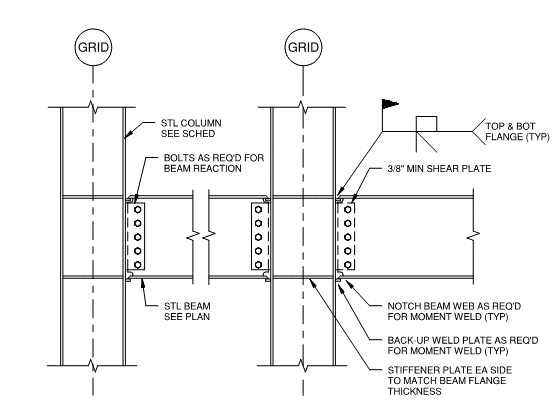
- They say “a chain is only as strong as its weakest link”, and that was certainly proven with the hanger rods at the Hyatt Regency. But our premises also aren’t worth much without valid reasoning connecting them together. In my own engineering niche of connection design, Bill Thornton, a leader in the field, has pointed out that most structural disasters have resulted from connection failures. The strongest beam imaginable won’t stay in place if you only provide one small bolt at each end. Our thoughts are similarly ineffective without being connected to one another correctly. However, when adequate framing is all connected together well, the pieces become locked into a stable, sound structure. Likewise, valid reasoning locks our true thoughts together into a sound argument.
- Just as a completed structure is greater than a pile of the same building materials laying on the ground, a completed argument is greater than the premises, for it gives us new information in the form of a true conclusion. For instance, the premise that “the universe began to exist”, and the premise that “anything that begins to exist has a cause” – by themselves – are like that pile of beams laying on the ground. It’s when we logically connect those thoughts together that we deduce the new truth that therefore “the universe must have a cause for its existence.” Building on that new conclusion, we reason that the cause of the space-time continuum must exist apart from space and time. A structure of knowledge begins to take shape as we continue adding new premises to build on previous conclusions, learning more and more characteristics of this spaceless, timeless, powerful, personal first cause that starts to look an awful lot like the God of the Bible.
I harp on logic a lot on this site, but for good reason. Whether you are checking out someone else’s view on a topic, or formulating your own, logic is your friend. For the Christian, God gave you a mind, and said to love Him with all of it [Mk 12:30]. Loving God for who He is requires learning about Him, and discerning truth from error. Moreover, we are told to test everything and hold fast to what is good [1Th 5:21], and to examine ourselves to see that we are in the faith [2Co 13:5]. Luke commended the Bereans for examining the Scriptures to see if Paul’s message corresponded to the truth of God’s Word [Ac 17:11]. Testing and examination require sound reasoning to judge what is true and determine what to do. The Christian is simply not allowed to put their brain in neutral. For the skeptics, you can attend “reason rallies” all you want, but reason is ultimately on God’s side. To paraphrase Augustine, all truth is God’s truth. That’s why I can have no doubts whatsoever that skeptics who follow the “load path” of their own worldview will find it resting on shifting sands, but if they continue to chase after truth, without rejecting God a priori, they will find their surety in God [Ac 17:26-27]. Blessings on you.


 I took an online class this fall taught by one of the leading experts in the world on connection design. He chairs several structural committees and has written much of the reference material for connection design for 30 years. I was struggling to follow what he was doing, and some other people were too, judging by the questions being asked. He chided us – rightfully so – for having become too reliant on computers and forgetting our “first principles”. For the structural engineer, these are things like free-body diagrams, moment and shear diagrams, and the equilibrium equations. These are foundational analysis methods for us, and it’s incumbent on the engineer to be familiar with the basic principles at work in complex situations. Sometimes, we might get lost in more advanced classes because we didn’t really comprehend the basic material when we studied it. Other times, it’s a case of never using it in practice and forgetting it. But in either case, the engineer lacking in these areas is responsible for correcting the situation, whether by studying hard to learn it anew, or refreshing old memories. In a class, it might be embarrassing to not remember the basics, but on the job many tragic engineering failures were ultimately traceable to neglecting basic principles.